Walk into a typical Korean-owned factory in Bac Ninh or Binh Duong today and you will see two systems running side by side: a Korean ERP that the headquarters reports against, and a wall of paper job sheets that the shop floor actually uses. The gap between those two systems is where margin disappears — usually 3–8% of revenue, every quarter, every year.
The hidden cost of the paper layer
The numbers we see most often, after a 4-week assessment of a Korean factory in Vietnam:
- Inventory variance between physical count and ERP: 8–15%
- Time-to-close monthly cost: 12–18 days (it should be 3–5)
- Production data that reaches Korea HQ in real time: 0%
- Defect rate the line lead actually knows about: lagged by one shift
None of these are exotic problems. They all come from the same root cause: the line workers are not entering data into a system. They are writing it on paper, and someone in the office types it into the ERP at the end of the day — minus the parts they forget.
MES vs ERP — what's what, in plain English
Korean factories often conflate the two. Quickly:
- ERP handles money: orders, inventory, BOM, costing, payroll. It runs in the office. SAP, Oracle, Korean ERPs (Douzone, Ecount) live here.
- MES handles minutes: which machine, which operator, which lot, what time, what quality. It runs on the shop floor — touchscreens, scanners, barcodes.
You need both, and they need to talk to each other. An ERP without an MES gives you accurate accounting of yesterday's mistakes. An MES without an ERP gives you operational data that nobody can act on financially.
What a modern MES looks like in Vietnam
For a 200–800 person Korean factory, the practical scope is:
- Tablet or industrial touchscreen at every workstation, in Vietnamese — operators tap to start/stop jobs, scan in materials, log defects
- Andon dashboard visible from the line lead's office — yellow when behind plan, red when stopped
- Auto-sync to ERP — work orders, completions, scrap flow into the office system overnight or in real time
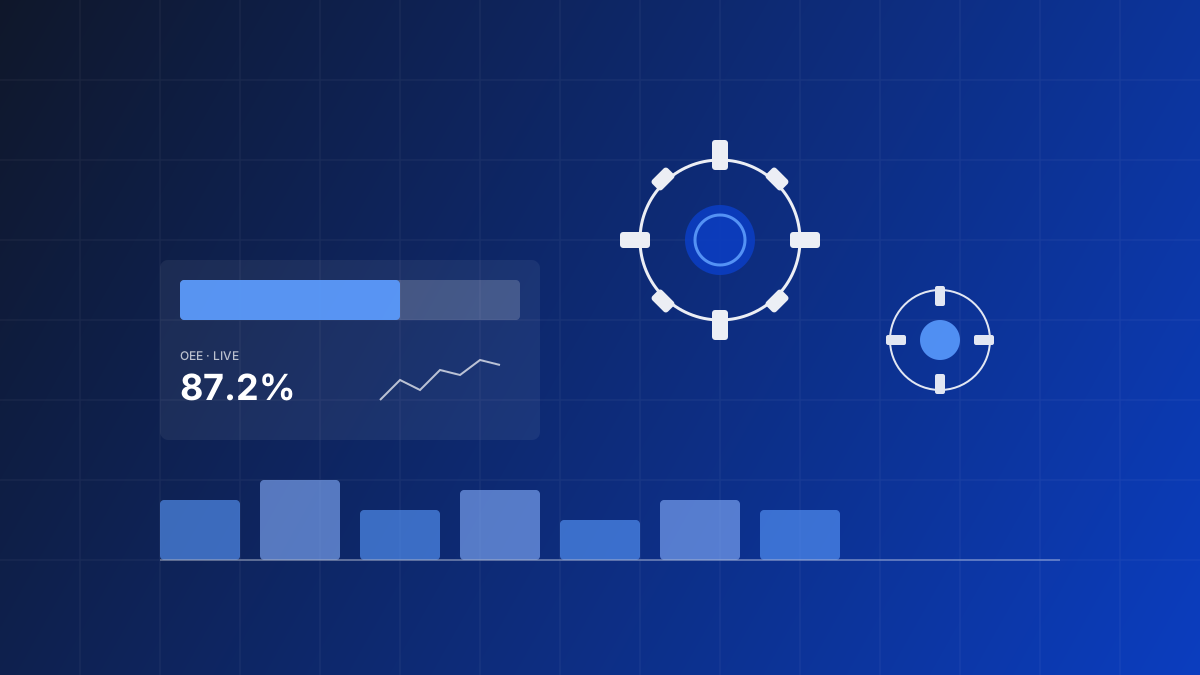
- OEE in real time — Overall Equipment Effectiveness, the one number that tells the plant manager what kind of day it is
One Korean garment factory in Hung Yen went from 18-day month-end close to 4 days, and from 12% inventory variance to 2.1%, in the first 6 months after MES rollout. ROI: 7 months. Total cost: less than 1 month of unnoticed inventory shrinkage.
Phased rollout — line by line, not big bang
The biggest mistake we see is plants that try to digitize 100% of operations in a single project. They take 18 months, fight the operators, and get a system nobody trusts.
The pattern that works:
- Pick one production line. Ideally the one with the most variability — that's where the savings are clearest.
- Roll out MES on that line in 6 weeks. Operators trained in Vietnamese, with a Korean-speaking PM coordinating with the line lead.
- Measure the before/after. Line yield, OEE, defect rate. Show the numbers to the rest of the plant.
- Roll out to the next line, then the next. Each line takes 4 weeks once the platform is in place.
By month 9, the whole plant is running on it. No big bang, no production stop, no resistance.
What about the ERP?
If you already have a Korean ERP at HQ, keep it. We integrate the Vietnam MES with the Korean ERP via a thin sync layer — work orders flow down, completions flow up. The Korea office sees the same dashboards as the Vietnam plant manager, in their own language.
If your Vietnam plant has no ERP yet (or only a manual Excel-based system), this is the moment to install one. Cloud ERP (Odoo, NetSuite, or our own SotaERP for SMEs) is fast, and integrates with the MES out of the box.
Where SotaTek fits
We have implemented MES in Korean-owned factories across electronics, garment, footwear, and food processing — usually as a 6-month engagement, with a Korean-speaking PM and a Hanoi-based engineering team. We integrate with Korean ERPs (Douzone, Ecount, SAP) and with the Vietnamese tax authority's e-invoicing system on the same project.
Want a 1-page assessment of where the savings are in your plant? Email gateway@sotatek.com with your factory size and product type — we'll send a free 60-minute audit framework.
Modernize your Vietnam plant — without stopping production.
30 minutes with our manufacturing team. We'll map the highest-ROI line to start with.
Book a 30-min Consultation